Abusing legacy railroad signaling systems
David Meléndez, Gabriela Gabs Garcia
DEF CON 32 Main Stage · Day 1 · Main Stage
Overview
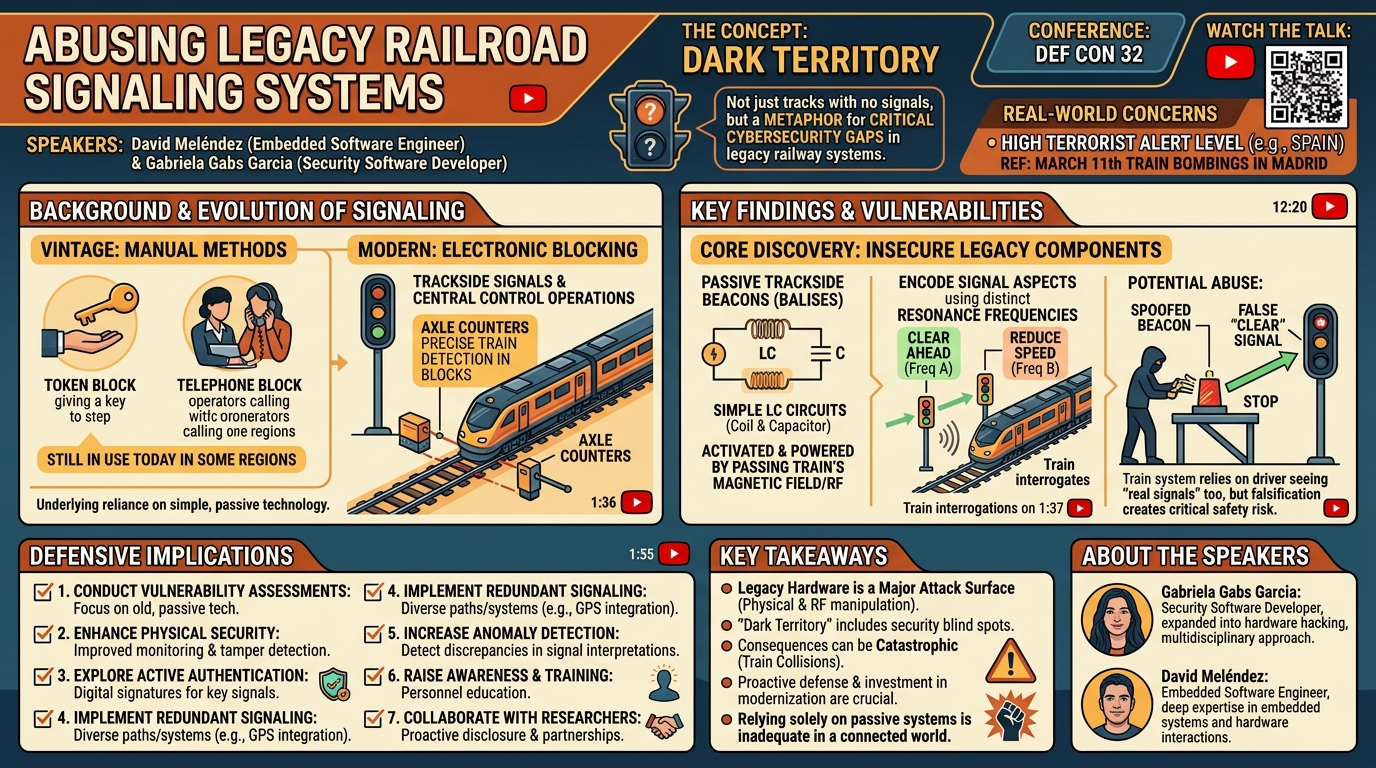
In "Abusing legacy railroad signaling systems," David Meléndez and Gabriela Gabs Garcia shed light on critical vulnerabilities within the foundational infrastructure of railway networks. Their DEF CON 32 talk delves into the often-overlooked security posture of older, yet still widely deployed, train control mechanisms. The speakers introduce the concept of "dark territory" – not just a railway term for sections without remote control or automatic blocking, but also a metaphor for areas of railway security that lack adequate supervision and scrutiny from a cybersecurity perspective.
Key moments
- 0:00 Introduction: Speakers and 'Dark Territory' concept
- 2:00 Fundamental railway concepts: blocks and axle counters
- 6:00 Discussing related risks and real-world incidents (e.g., Spain)
- 8:40 How trackside signals change resonance for train aspects
- 10:00 Passive devices and 'black magic' of frequencies explained
- 11:50 Evolution of train blocking: token, telephone, electronic
Abusing legacy railroad signaling systems
Speakers: David Meléndez, Embedded Software Engineer; Gabriela Gabs Garcia, Security Software Developer
Conference: DEF CON 32
YouTube: https://www.youtube.com/watch?v=RHhyrcgm7n4
Overview
In "Abusing legacy railroad signaling systems," David Meléndez and Gabriela Gabs Garcia shed light on critical vulnerabilities within the foundational infrastructure of railway networks. Their DEF CON 32 talk delves into the often-overlooked security posture of older, yet still widely deployed, train control mechanisms. The speakers introduce the concept of "dark territory" – not just a railway term for sections without remote control or automatic blocking, but also a metaphor for areas of railway security that lack adequate supervision and scrutiny from a cybersecurity perspective.
This presentation is particularly significant due to the profound safety and national security implications of railway infrastructure. Meléndez and Garcia highlight that, especially in regions like Spain, where past terrorist incidents have involved train systems, the potential for malicious exploitation of these vulnerabilities is a pressing concern. Their work serves as a crucial wake-up call, urging greater investment and attention to the safety and security of legacy railway signaling, emphasizing that any motivated individual with sufficient knowledge could potentially exploit these systems to catastrophic effect.
Background
▶ Watch: Introduction: Speakers and 'Dark Territory' concept (0:00)
The evolution of railway signaling systems has seen a progression from purely manual methods to increasingly automated and electronic controls. Meléndez and Garcia provide a historical overview, starting with the fundamental concept of a railway block – a critical safety measure ensuring that only one train occupies a specific section of track at any given time, thereby preventing collisions. To manage these blocks, various methods have been employed throughout history, each with its own level of technological sophistication and inherent security considerations.
Historically, the token block system represented a vintage, manual approach where a physical token was handed to a train operator, signifying permission to enter a block. This was followed by the telephone block, a slightly more advanced, but still manual, system where operators would communicate via telephone to coordinate train movements between blocks. While seemingly antiquated, the speakers note that these methods are still in use in some parts of the world, highlighting the long operational lifespan of railway infrastructure and the potential for legacy systems to persist alongside newer technologies.
The advent of electronic train blocking marked a significant technological leap. These systems utilize trackside signals and central control operation centers to manage railway slices, blocking sections when a train is present. A key component of these electronic systems is the axle counter, which precisely counts the axles of trains entering and exiting a block. This ensures that the entire train has passed through, preventing parts of a train from being left behind and ensuring accurate block occupancy detection. The underlying challenge, and the focus of the talk, is that even these "electronic" systems often rely on surprisingly simple, passive, and potentially vulnerable technologies for their core signaling functions.
The speakers emphasize that their investigation was spurred by real-world concerns, particularly Spain's heightened terrorist alert level. They reference the devastating March 11th train bombings in Madrid, which profoundly impacted public perception of railway security. This historical context underscores the severe consequences of railway system compromise and frames their research as a proactive effort to identify and mitigate risks before another incident occurs.
Key Findings
▶ Watch: Discussing related risks and real-world incidents (e.g., Spain) (6:00)
Meléndez and Garcia's primary discovery revolves around the inherent insecurity of widely deployed legacy railway signaling components, specifically the passive trackside devices that communicate critical information to passing trains. They identify that many such systems rely on simple passive devices embedded in the track, which are activated and powered solely by the magnetic field or radio frequency energy emitted by a passing train. These devices, often referred to as balises or beacons, are crucial for conveying signal aspects (e.g., speed limits, stop signals) to the train's onboard systems.
The core of their finding is that these passive beacons operate on a principle akin to a basic LC circuit (inductor-capacitor circuit). They consist of a coil and a capacitor in a closed loop, requiring no external power source like batteries or integrated circuits. The crucial aspect is that these circuits are designed to exhibit different resonance frequencies or electrical states depending on the signal aspect they need to convey. When a train passes over them, its onboard system interrogates these passive devices, detecting their resonant frequency and interpreting it as a specific instruction or status update.
The vulnerability stems from the simplicity and passive nature of these circuits. By understanding the specific frequencies or electrical states corresponding to different signal aspects, an attacker could potentially:
- Impersonate a beacon: By creating a device that mimics the resonant frequency of a specific signal aspect, an attacker could transmit false information to a train.
- Manipulate existing signals: Although not explicitly detailed how, the implication is that if one can understand the "black magic" of how these circuits behave differently based on frequency, it might be possible to alter the perceived state of a legitimate beacon.
The speakers highlight that the system relies on the train driver also seeing the "real signals," implying these trackside beacons act as an "acknowledge system" to confirm the driver has seen and understood the correct signal. This redundancy, while a safety feature, does not entirely negate the risk of false information being transmitted to the train's onboard systems, potentially leading to incorrect automated actions or driver confusion. Their work exposes a gap where physical security and the simplicity of legacy hardware create a significant attack surface in critical infrastructure.
Technical Deep Dive
▶ Watch: How trackside signals change resonance for train aspects (8:40)
The technical foundation of the vulnerabilities explored by Meléndez and Garcia lies in the fundamental principles of resonant circuits and their application in legacy railway signaling. At the heart of these trackside beacons is an LC circuit, comprising an inductor (coil) and a capacitor connected in a closed loop. This circuit is inherently passive, meaning it does not generate its own power or actively transmit signals using an internal power source. Instead, it relies on energy transfer from an external source.
When a train's onboard system passes over one of these beacons, it emits an electromagnetic field or a specific interrogating frequency. This energy inductively couples with the beacon's coil, energizing the LC circuit. The key property of an LC circuit is its resonant frequency, which is determined by the specific values of its inductance (L) and capacitance (C). At its resonant frequency, the circuit will store and transfer energy most efficiently.
The ingenious, yet now vulnerable, design choice in these legacy systems is to encode different signal aspects by physically altering the characteristics of the LC circuit within the beacon. For example, a beacon signaling "clear ahead" might have a different inductance or capacitance value (or a combination thereof, perhaps involving additional components switched in or out) than a beacon signaling "reduce speed" or "stop." These physical changes result in distinct resonant frequencies or impedance characteristics.
When the train's system interrogates the beacon, it effectively "reads" this resonant frequency or electrical state. The train's receiver is tuned to detect these specific responses. A particular frequency or impedance signature is then decoded as a specific instruction for the train, such as:
- Speed limits: Different frequencies could correspond to different maximum allowable speeds.
- Block occupancy: Signaling whether the next block is clear or occupied.
- Signal aspects: Indicating the state of a visual signal (e.g., green, yellow, red).
The speakers describe this mechanism as "black magic" due to its seemingly simple yet effective operation, where "the circuit behave differently accordingly to the frequency that you put in that circuit." This implies that the train's interrogating system sweeps through a range of frequencies or uses a specific frequency to excite the beacon, and the beacon's response (or lack thereof, or a specific resonant peak) dictates the information conveyed.
The vulnerability arises because these passive devices, lacking cryptographic protections or complex authentication mechanisms, are susceptible to emulation. An attacker with sufficient knowledge of electronics and radio frequency (RF) principles could construct their own device that mimics the resonant frequency signature of a desired, potentially dangerous, signal aspect. For instance, an attacker could create a device that resonates at the frequency corresponding to a "clear ahead" signal, even if the actual track ahead is occupied or a stop signal is displayed.
Furthermore, the physical nature of these systems means that if an attacker gains physical access to the trackside beacons, they could potentially tamper with the internal components (e.g., add or remove capacitance/inductance) to alter their intended resonant frequency. The mention of "gluing all the of the wire to make to make sure that the center frequency remains at the target frequency" could refer to the precision required in manufacturing or maintaining these circuits, implying that even slight physical alterations could change their behavior. This highlights a critical intersection of physical security and cyber-physical system vulnerability.
The reliance on basic electrical properties, while robust against software bugs or network attacks, leaves these systems exposed to hardware-level manipulation or RF spoofing. The lack of active components means no complex digital signatures, encryption, or challenge-response mechanisms are typically present, making it easier for an adversary to replicate or interfere with the intended signal.
Demo / Proof of Concept
▶ Watch: Passive devices and 'black magic' of frequencies explained (10:00)
The transcript indicates that David Meléndez and Gabriela Gabs Garcia were actively developing a proof of concept (PoC) for their research, rather than demonstrating a completed one during the talk. Meléndez explicitly states, "We are we are already have the tester. So, we need to make the the beacon itself." This suggests that while they had developed or acquired equipment capable of interrogating and analyzing the signals from legitimate trackside beacons ("the tester"), they were still in the process of constructing their own malicious beacon to emulate specific signal aspects.
Therefore, no live demonstration of an exploited system or a fully functional malicious beacon was presented. The focus of the talk was primarily on the theoretical understanding of the vulnerabilities in these legacy systems and the potential for their abuse. Had a full PoC beacon been developed, it would likely involve an LC circuit designed to resonate at frequencies corresponding to dangerous or misleading railway signals, demonstrating how false information could be transmitted to a passing train's onboard systems.
Defensive Implications
▶ Watch: Evolution of train blocking: token, telephone, electronic (11:50)
The findings presented by Meléndez and Garcia carry significant defensive implications for railway operators and national security agencies. The primary takeaway is the urgent need to address the vulnerabilities inherent in legacy railway signaling systems, particularly those relying on passive, unauthenticated trackside beacons.
Defenders should consider the following actions:
- Conduct Comprehensive Vulnerability Assessments: Railway operators must undertake detailed security assessments of all deployed signaling systems, with a particular focus on older, passive technologies. This includes identifying the exact specifications of trackside beacons, their operating frequencies, and the methods by which they communicate with trains.
- Enhance Physical Security: Given that these passive beacons are often physically accessible along railway tracks, robust physical security measures are paramount. This includes improved monitoring, tamper detection mechanisms, and restricted access to trackside infrastructure to prevent direct manipulation or replacement of legitimate beacons with malicious ones.
- Explore Active Authentication Mechanisms: For critical signal aspects, reliance on purely passive, unauthenticated LC circuits is no longer sufficient. Operators should investigate and implement active authentication mechanisms for trackside-to-train communication. This could involve cryptographic challenges, unique digital signatures, or more complex active transponders that can verify the authenticity of signals.
- Implement Redundant and Diverse Signaling: While some redundancy exists (e.g., visual signals for drivers), the talk highlights the need for diverse and independent signaling paths. If one system is compromised, another should be able to detect and override dangerous instructions. This could involve integrating GPS-based train positioning systems with traditional trackside signaling, or utilizing multiple, disparate communication technologies.
- Increase Monitoring and Anomaly Detection: Enhanced monitoring of train movements and signal interpretations can help detect anomalies that might indicate a system compromise. For example, if a train receives a "clear ahead" signal but its speed or position data suggests an obstruction, this discrepancy should trigger an immediate alert and safety protocol.
- Invest in Modernization and Upgrades: Ultimately, the long-term solution involves modernizing legacy systems with technologies that incorporate robust cybersecurity features by design. This includes migrating to digital, encrypted communication protocols and systems that are less susceptible to physical emulation or RF spoofing.
- Raise Awareness and Training: Personnel involved in railway operations, maintenance, and security need to be educated about these types of hardware-level vulnerabilities. Awareness campaigns can help identify suspicious activities or potential tampering.
- Collaborate with Security Researchers: Engaging with the security research community, as Meléndez and Garcia have done, is crucial. Proactive disclosure and collaborative efforts can help identify vulnerabilities before they are exploited by malicious actors.
The speakers' call for increased investment in railway safety and security is not merely about preventing accidents, but about safeguarding critical infrastructure against sophisticated, motivated adversaries. The simplicity of these legacy systems, while a testament to their original engineering, now represents a significant attack surface that demands immediate attention.
Key Takeaways
- Legacy Systems are Vulnerable: Many existing railway signaling systems rely on simple, passive hardware (LC circuits) that are susceptible to physical manipulation or RF emulation.
- "Dark Territory" Extends to Security: Beyond railway operations, "dark territory" describes areas of railway infrastructure security that lack adequate scrutiny and investment, leaving them open to exploitation.
- Passive Beacons are Key Attack Vectors: Trackside beacons, powered by passing trains, use resonant frequencies to convey signal aspects. These can be mimicked by an attacker to send false information.
- Physical Security is Paramount: Due to the hardware-centric nature of these vulnerabilities, robust physical security measures around trackside infrastructure are essential to prevent tampering.
- Consequences are Severe: Exploiting these systems could lead to catastrophic train collisions, highlighting the critical need for proactive security measures and increased investment in railway safety.
- Modernization and Authentication are Crucial: Long-term defense requires moving beyond passive, unauthenticated systems towards modern, cryptographically secured communication and signaling protocols.
About the Speaker(s)
Gabriela Gabs Garcia is a security software developer who has expanded her expertise into hardware hacking. Her interest in the field was sparked by the hardware hacker community, which introduced her to the unique challenges and opportunities in this domain. Her background in software development combined with her hardware hacking skills provides a multidisciplinary approach to uncovering vulnerabilities in complex systems like railway infrastructure.
David Meléndez is an embedded software engineer. His deep understanding of embedded systems and their interaction with hardware components is crucial to the research presented. Together with Gabriela, he brings a specialized perspective to the intricate workings of railway signaling, focusing on how these systems can be analyzed and potentially exploited from an engineering standpoint. Their combined expertise allows for a comprehensive assessment of both the software and hardware aspects of critical infrastructure security.
Reviews
Dr. Zero (Offensive Security Researcher) — STRONG ACCEPT
Meléndez and Garcia's research into legacy railroad signaling systems at DEF CON 32 is a crucial deep dive into an overlooked, yet incredibly high-impact, attack surface. By exposing the fundamental vulnerabilities in passive trackside beacons that rely on simple LC circuits, they highlight a critical national security and safety issue. While a full live demo was still in development, the technical explanation of how these systems can be spoofed or manipulated provides actionable intelligence for defenders, making this a significant contribution to critical infrastructure security.