A Shadow Librarian: Fighting back against encroaching capitalism
Daniel Messe
DEF CON 32 Main Stage · Day 1 · Main Stage
Overview
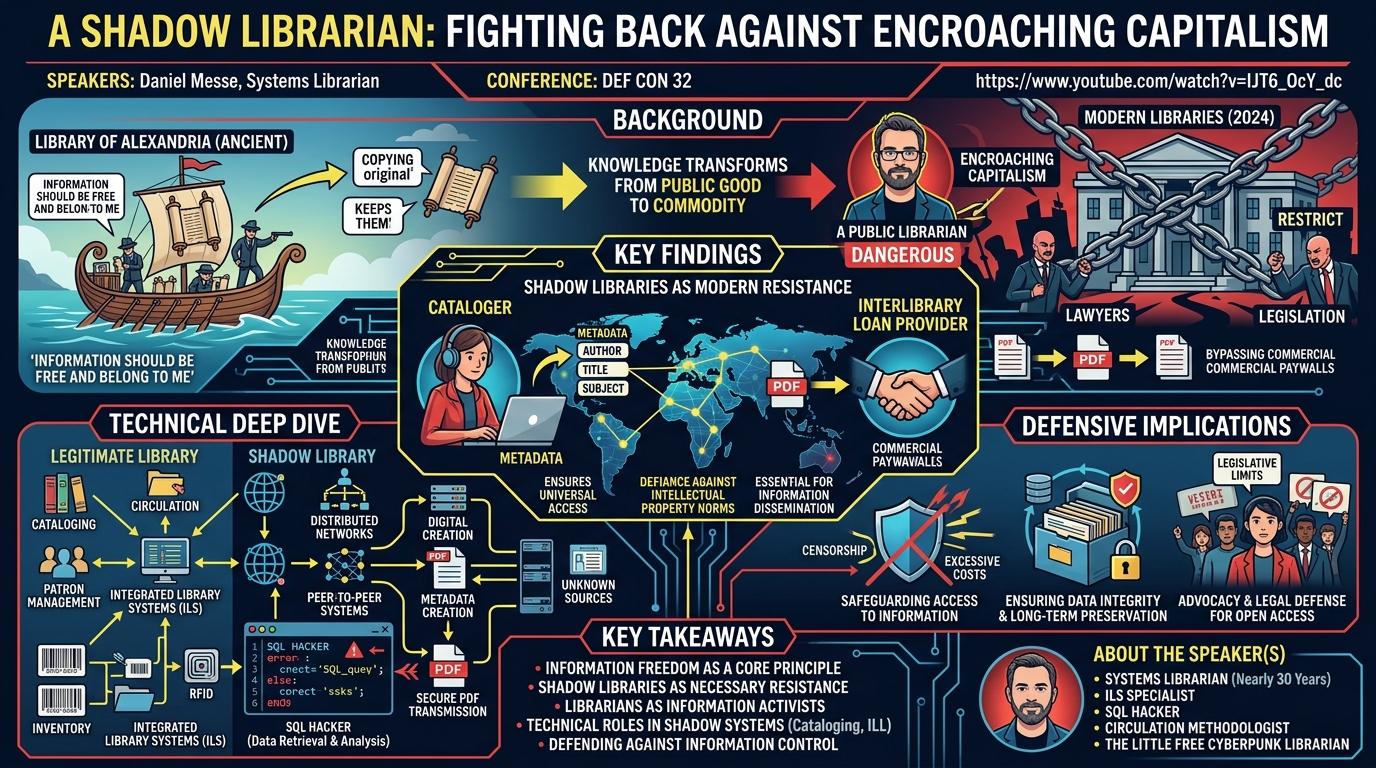
Daniel Messe's DEF CON 32 talk, "A Shadow Librarian: Fighting back against encroaching capitalism," offered a provocative reinterpretation of the librarian's role in the digital age, framing it as a form of information activism akin to hacking. Messe, a systems librarian with nearly three decades of experience, argued that librarians, like hackers, are increasingly viewed as a threat to established systems, particularly in their fight against the commercialization and restriction of knowledge. The presentation served as a rallying cry for information freedom, drawing parallels between the aggressive acquisition policies of the ancient Library of Alexandria and the modern phenomenon of shadow libraries.
Key moments
- 0:00 Welcome and Speaker Introduction
- 0:48 Librarians: Fing Dangerous
- 2:30 Alexandrian Library's bold book acquisition strategy
- 3:00 Modern libraries' legal challenges for information freedom
- 4:00 Speaker's humorous definition of 'SQL hacking'
- 8:50 The 'Little Free Cyberpunk Librarian' and shadow libraries
A Shadow Librarian: Fighting back against encroaching capitalism
Speakers: Daniel Messe, Systems Librarian
Conference: DEF CON 32
YouTube: https://www.youtube.com/watch?v=IJT6_OcY_dc
Overview
Daniel Messe's DEF CON 32 talk, "A Shadow Librarian: Fighting back against encroaching capitalism," offered a provocative reinterpretation of the librarian's role in the digital age, framing it as a form of information activism akin to hacking. Messe, a systems librarian with nearly three decades of experience, argued that librarians, like hackers, are increasingly viewed as a threat to established systems, particularly in their fight against the commercialization and restriction of knowledge. The presentation served as a rallying cry for information freedom, drawing parallels between the aggressive acquisition policies of the ancient Library of Alexandria and the modern phenomenon of shadow libraries.
The talk challenged the traditional perception of librarians, positioning them not as quiet custodians of books, but as frontline defenders against what Messe termed "encroaching capitalism" in the realm of information. He highlighted how legislative efforts and commercial interests are increasingly curtailing the ability of public libraries to fulfill their mission of universal access. By embracing the moniker "cyberpunk librarian" and actively participating in shadow libraries, Messe advocated for a radical approach to information dissemination, emphasizing that "information should be free and it should belong to me."
This presentation is highly relevant to the cybersecurity community because it delves into fundamental principles of information access, control, and censorship—issues that resonate deeply with the hacker ethos. It explores how systemic barriers to knowledge can be circumvented through alternative, often unsanctioned, networks. Messe's insights underscore the critical importance of digital preservation, metadata integrity, and the ethical responsibility of ensuring public access to information, even when it challenges commercial models and legal frameworks.
Background
▶ Watch: Welcome and Speaker Introduction (0:00)
The core premise of Messe's talk rests on a historical analogy and a contemporary critique. He began by recounting the legendary acquisitions department of the ancient Library of Alexandria. Under a decree by Ptolemy II Philadelphus, agents were ordered to search ships docking in the bustling trade city, "borrowing" any books found. These originals were then copied, added to the library's vast collection, and often, the ships sailed away with only the copies, while the library retained the invaluable originals. Messe presented this as the first large-scale embodiment of the adage: "information should be free and it should belong to me." This historical precedent establishes a foundational principle of aggressive, proactive information acquisition for the public good, regardless of original ownership or commercial rights.
Messe starkly contrasted this ancient practice with the realities of modern libraries in 2024. He lamented that any library attempting such a feat today would be inundated with legal challenges, facing "more lawyers at their front door than they have children attending the herpetologist event at a summer reading program." This highlights the dramatic shift in the legal and economic landscape surrounding information. The fundamental problem, according to Messe, is "encroaching capitalism," which has transformed knowledge from a public good into a commodity. Publishers and content creators, supported by stringent copyright laws and licensing agreements, increasingly restrict access, making it expensive or impossible for libraries to acquire and freely disseminate materials.
Furthermore, Messe pointed to a concerning trend of legislative actions specifically targeting librarians. He asserted that "more legislation has been passed in the last few months to curtail my activities than have been passed to curtail yours [hackers] because I am fucking dangerous. I am a public librarian." This statement underscores the perceived threat librarians pose to established power structures when they advocate for unrestricted information access. These legislative efforts, often driven by political or commercial agendas, aim to limit what materials libraries can offer, particularly in public and school settings, thereby creating artificial scarcity and control over knowledge. This environment fosters the necessity and growth of shadow libraries as a direct response to these systemic barriers, attempting to reclaim the spirit of Alexandria in a digital, decentralized form.
Key Findings
▶ Watch: Alexandrian Library's bold book acquisition strategy (2:30)
Daniel Messe's key findings revolve around the critical role of shadow libraries as a modern response to the commercialization and restriction of information, drawing a powerful parallel to the ancient Library of Alexandria. He argues that these unofficial, often illicit, repositories are essential for maintaining the principle of universal access to knowledge in an era where traditional libraries are increasingly constrained.
First, Messe identifies the historical precedent set by the Library of Alexandria, whose aggressive acquisitions policy—copying every book found on ships and keeping the originals—serves as a philosophical blueprint for modern information freedom movements. This historical context frames shadow libraries not as mere piracy, but as a continuation of a long-standing mission to collect and preserve knowledge for all.
Second, he highlights the practical functions and specialized roles within these shadow libraries. Messe, who has been researching shadow libraries for about 10 years and actively participates in them, described two primary functions:
- Cataloger: In this role, Messe helps provide metadata for "ebooks of questionable sources" that lack proper descriptive information. This is crucial for discoverability and organization within large, distributed collections, mirroring the meticulous work of catalogers in traditional libraries. Without robust metadata, vast digital archives become unusable.
- Interlibrary Loan Provider: Messe also facilitates the digital equivalent of an interlibrary loan, where "someone on the internet needs a PDF and I can provide that PDF." This bypasses commercial paywalls and licensing restrictions, directly providing users with the content they seek, often academic papers or books that would otherwise be prohibitively expensive or inaccessible.
Third, Messe makes a compelling argument that librarians, particularly those involved in shadow libraries, embody a form of defiance that is feared by authorities, much like hackers. He stated, "People are starting to fear others like me too... I am a threat. And so are people like me." This fear stems from their commitment to open access, which challenges intellectual property norms and commercial monopolies over information. By actively participating in the shadow information economy, librarians are, in Messe's view, engaging in a necessary form of resistance against the "encroaching capitalism" that seeks to privatize and control knowledge. This positions librarians as crucial, albeit unconventional, actors in the broader fight for information security and freedom.
Technical Deep Dive
▶ Watch: Modern libraries' legal challenges for information freedom (3:00)
While Daniel Messe's talk did not delve into traditional cybersecurity exploits or vulnerabilities, it provided a unique "technical deep dive" into the infrastructure, methodologies, and operational aspects of information management, both in legitimate libraries and the shadow libraries he champions. The technical insights shared relate fundamentally to how information is organized, accessed, and distributed, which are core concerns for any information security professional.
At the heart of modern library operations are Integrated Library Systems (ILS). Messe, as a systems librarian for nearly 30 years, specializes in these systems, describing them as the "day-to-day operating system of a modern library." ILS platforms manage the entire lifecycle of library materials, from acquisition and cataloging to circulation (checking items in and out), patron management, and inventory control. These systems typically comprise complex databases that store extensive metadata about each item—author, title, publication date, subject headings, classification numbers (e.g., Dewey Decimal or Library of Congress), and physical location. The efficiency and accuracy of an ILS are paramount for a library's ability to serve its patrons.
Messe also self-identifies as a "SQL hacker," albeit with humor. He describes his process as writing a query, swearing because it doesn't work, rewriting it, swearing less, and finally getting it to work. Despite the self-deprecating tone, this highlights a critical technical skill: the ability to interact directly with and manipulate the underlying databases of library systems. SQL (Structured Query Language) is fundamental for data retrieval, analysis, and management in most relational databases. In a legitimate library context, SQL skills are vital for generating reports, auditing collections, optimizing search functions, and performing bulk data operations. In the context of shadow libraries, such skills could be invaluable for extracting, transforming, and loading metadata, or for querying large, unofficial repositories to fulfill specific requests.
Beyond software, Messe touched upon library technology hardware, including self-checkout machines, self-check-in machines, barcodes, and RFID tags. These technologies are integral to the physical logistics of libraries, enabling efficient tracking and management of physical items. RFID (Radio-Frequency Identification) tags, for instance, allow for rapid inventory checks and improved security against theft, by uniquely identifying each item and communicating with readers at exits or within inventory systems. While these are primarily physical infrastructure, they represent the technological underpinnings that facilitate the flow of information within a controlled environment.
In the realm of shadow libraries, the technical focus shifts from institutional systems to distributed, often peer-to-peer or server-based, networks for disseminating digital content. Messe's role as a cataloger in shadow libraries is inherently technical. It involves analyzing "ebooks of questionable sources" and creating or refining their metadata. This is not merely clerical work; it requires knowledge of metadata standards (e.g., MARC, Dublin Core, ONIX), understanding of content structure, and often the use of specialized tools to embed this metadata directly into digital files (like PDFs or EPUBs). Accurate and consistent metadata is the backbone of any searchable digital collection, ensuring that users can find the information they need, even if the collection itself exists outside traditional legal frameworks.
Similarly, his work as an "interlibrary loan provider" in shadow libraries involves the technical process of locating, retrieving, and securely transmitting PDFs or other digital formats to individuals. This often requires navigating various unofficial archives, understanding different file-sharing protocols (though not explicitly detailed in the talk), and ensuring the integrity and usability of the delivered document. While Messe did not specify the exact protocols or architectures of the shadow libraries he participates in, the implication is a decentralized, resilient system designed to bypass censorship and commercial barriers, leveraging digital formats and metadata to ensure broad access. This conceptual architecture, focused on availability and accessibility despite legal challenges, mirrors the goals of many open-source and anti-censorship technical projects.
Demo / Proof of Concept
▶ Watch: Speaker's humorous definition of 'SQL hacking' (4:00)
Daniel Messe's talk did not feature a live technical demonstration or a proof of concept in the traditional DEF CON sense, such as exploiting a system or showcasing a new tool. He explicitly stated early in his presentation, "I'm not a hacker. I am not a cybersecurity expert. I will not be talking about how I crack some passwords that I found on the dark web and use that to infiltrate some system. I won't be talking about that because that's nothing I have ever done."
Instead, the "proof of concept" for Messe's arguments was his own professional and extracurricular involvement. His nearly 30 years as a systems librarian, specializing in Integrated Library Systems (ILS), and his self-described "SQL hacking" demonstrate his deep understanding of information infrastructure. More significantly, his decade-long research into and active participation in shadow libraries—working as a cataloger to provide metadata for "ebooks of questionable sources" and as an "interlibrary loan provider" to supply PDFs to those in need—serves as a living testament to the viability and necessity of these alternative information networks. His personal actions and roles within these shadow systems illustrate the practical application of his philosophy that information should be free, directly countering the restrictive forces of "encroaching capitalism."
Defensive Implications
▶ Watch: The 'Little Free Cyberpunk Librarian' and shadow libraries (8:50)
For traditional cybersecurity defenders, Daniel Messe's talk offers a critical perspective on the broader landscape of information security, availability, and integrity, extending beyond network perimeters and data breaches. The "defensive implications" here are less about patching systems and more about safeguarding the fundamental right to information access in an increasingly controlled digital world.
Firstly, the talk highlights the vulnerability of public knowledge to commercial and political control. Just as hackers defend against attacks on systems, librarians (and their allies) are defending against attacks on the free flow of information. Defenders should recognize that restricting access to information, whether through exorbitant licensing fees, aggressive copyright enforcement, or outright censorship (as implied by the "legislation passed... to curtail my activities"), constitutes a threat to intellectual freedom and an informed populace. This is a form of information warfare waged not with exploits, but with economic and legal levers.
Secondly, for organizations concerned with data integrity and long-term preservation, the rise of shadow libraries signals a systemic failure in legitimate information ecosystems. If critical research, historical documents, or cultural works become inaccessible through official channels, their preservation and availability fall to unofficial networks. This raises questions about the long-term integrity, authenticity, and sustainability of such shadow archives. Cybersecurity professionals, particularly those in archival or academic institutions, should consider how to bolster legitimate digital preservation efforts to reduce the reliance on potentially fragile or legally precarious shadow systems.
Thirdly, the emphasis on metadata by Messe (through his role as a cataloger in shadow libraries) underscores its critical importance for discoverability and organization. In any large dataset or information repository, accurate and comprehensive metadata is essential for users to find and understand content. Defenders should advocate for robust metadata standards and practices in all digital collections, recognizing that poor metadata can effectively hide information, making it as inaccessible as if it were behind a paywall.
Finally, Messe's assertion that librarians are "dangerous" and feared suggests a need for advocacy and legal defense for those who champion open access. The "defenders" in this context are not just technical experts but also policymakers, lawyers, and civil liberties advocates who must resist legislative efforts that curtail information freedom. For the cybersecurity community, which often operates on principles of open knowledge and collaboration, understanding and supporting these broader battles for information access is crucial. It means recognizing that the fight for "information should be free" is a multi-faceted one, involving legal, economic, and technical fronts, and that "shadow libraries" are a symptom of, and a response to, systemic vulnerabilities in the global information infrastructure.
Key Takeaways
- Information Freedom as a Core Principle: The talk champions the idea that information should be freely accessible to all, drawing historical parallels to the aggressive acquisition policies of the ancient Library of Alexandria.
- Shadow Libraries as Modern Resistance: Shadow libraries are presented as a necessary response to "encroaching capitalism" and restrictive legislation that limit access to knowledge through traditional library systems.
- Librarians as Information Activists: Daniel Messe reframes librarians as "cyberpunk librarians" and "threats" to established systems, actively fighting for information access in ways that challenge commercial and legal norms.
- Technical Roles in Shadow Libraries: Participation in shadow libraries involves specialized technical skills like cataloging (providing crucial metadata for discoverability) and facilitating "interlibrary loans" (distributing PDFs), demonstrating a decentralized information infrastructure.
- Defending Against Information Control: The talk implies that defending information access requires understanding and resisting legislative, economic, and technological barriers that privatize or censor knowledge, advocating for robust metadata and open access policies.
About the Speaker(s)
Daniel Messe is a highly experienced systems librarian with a career spanning almost 30 years. His expertise lies in integrated library systems (ILS), which he describes as the "day-to-day operating system of a modern library," managing everything from circulation to cataloging. He also engages in SQL hacking, a self-taught skill used for data analysis and storytelling within library contexts, and is proficient in various library technologies, including barcodes and RFID tags. Messe identifies as a circulation methodologist, helping libraries optimize material flow. He is widely known in library podcast circles as "your little free cyberpunk librarian" due to his outspoken advocacy for information freedom. For approximately a decade, he has actively researched and participated in shadow libraries, serving as a cataloger (providing metadata for questionable ebooks) and an interlibrary loan provider (supplying PDFs to those in need).
Reviews
Dr. Zero (Offensive Security Researcher) — STRONG ACCEPT
This talk delivers a potent and timely message, recontextualizing the role of librarians as frontline information activists in the digital age. Messe brilliantly draws parallels between the ancient Library of Alexandria's aggressive acquisition policies and modern "shadow libraries," framing the fight against "encroaching capitalism" as a critical battle for information freedom. While not a traditional technical deep-dive into exploits, it offers a substantive look into the operational realities of information control and subversion, highlighting the crucial technical work of metadata and digital distribution necessary to circumvent systemic barriers. It's a compelling call to action that…
Heather Calloway (CISO) — STRONG ACCEPT
Daniel Messe's talk at DEF CON 32, "A Shadow Librarian," offers a crucial, albeit unconventional, perspective on information security by framing the battle for open knowledge as a fight against systemic control. He effectively highlights the governance failures that lead to critical information being locked away, compelling us to consider the real-world business and societal impact when knowledge becomes a commodity. While not a direct technical deep-dive for a security operator, it is a powerful call to action for institutional leaders and policymakers, underscoring the necessity of advocating for and actively preserving information freedom against encroaching commercial and legislative…