D-Helix: A Generic Decompiler Testing Framework Using Symbolic Differentiation
Muqi Zou (Purdue University)
33rd USENIX Security Symposium · Day 1 · USENIX Security '24 · USENIX Security '24
Overview
In the intricate world of binary analysis, decompilers serve as critical tools, translating low-level machine code back into human-readable high-level languages like C. This talk, "D-Helix: A Generic Decompiler Testing Framework Using Symbolic Differentiation," presented by Muqi Zou from Purdue University, addresses a fundamental and often overlooked challenge in decompilation: semantic preservation. While decompilers aim to produce functionally equivalent high-level code, the underlying heuristics frequently introduce subtle semantic inaccuracies that can severely impact the reliability of reverse engineering, vulnerability analysis, and malware investigation.
Key moments
- 1:00 Decompilation's semantic preservation problem and inaccuracies
- 2:00 Overview of the D-Helix decompiler testing framework
- 4:00 Detailed explanation of symbolic model generation
- 4:20 Evaluation results: 25 bugs found in Ghidra and Angr
- 6:00 Case study 1: Incorrect usage of Dwarf information
- 8:00 Case study 2: Constant 128 decompiled as -128
- 9:50 Summary of D-Helix and key contributions
D-Helix: A Generic Decompiler Testing Framework Using Symbolic Differentiation
Speakers: Muqi Zou
Conference: USENIX Security '24
YouTube: https://www.youtube.com/watch?v=P4TtXmWZaBs
Overview
In the intricate world of binary analysis, decompilers serve as critical tools, translating low-level machine code back into human-readable high-level languages like C. This talk, "D-Helix: A Generic Decompiler Testing Framework Using Symbolic Differentiation," presented by Muqi Zou from Purdue University, addresses a fundamental and often overlooked challenge in decompilation: semantic preservation. While decompilers aim to produce functionally equivalent high-level code, the underlying heuristics frequently introduce subtle semantic inaccuracies that can severely impact the reliability of reverse engineering, vulnerability analysis, and malware investigation.
The presentation introduces D-Helix, an innovative and generic framework designed to automatically evaluate the correctness of decompilation results. By employing a novel approach based on symbolic differentiation, D-Helix can systematically identify discrepancies between the original binary's semantics and the semantics of the decompiler's output. This capability is paramount for enhancing the trustworthiness of decompilers and providing developers with a robust mechanism to debug and refine their complex codebases.
The significance of D-Helix stems from its ability to tackle a pervasive problem that has largely remained unaddressed by existing decompiler testing methodologies. The framework uncovers a range of previously unknown bugs in widely used decompilers, highlighting the critical need for rigorous semantic verification. For anyone involved in binary analysis, reverse engineering, or decompiler development, D-Helix offers a promising path toward more reliable and semantically accurate high-level code recovery.
Background
▶ Watch: Decompilation's semantic preservation problem and inaccuracies (1:00)
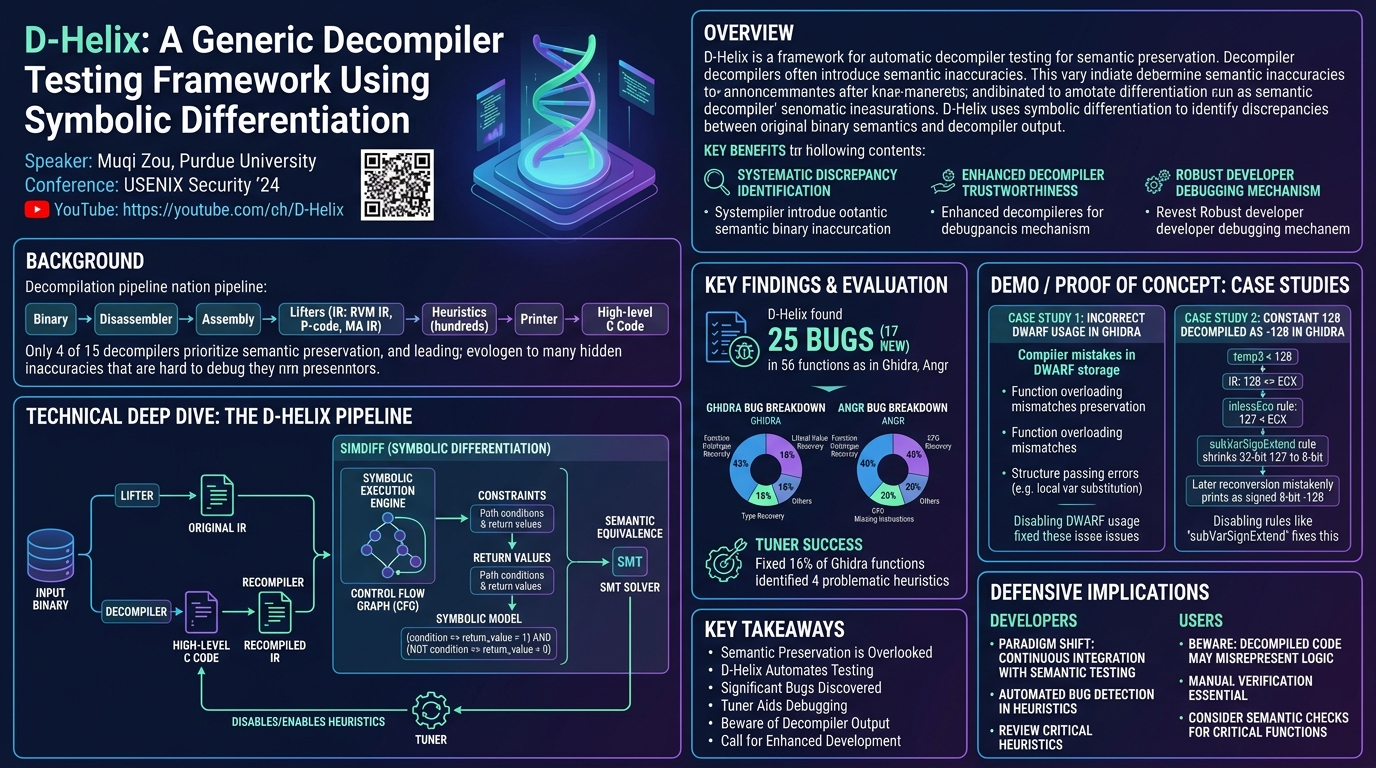
The process of decompilation is a multi-stage pipeline designed to reverse engineer compiled binaries into high-level source code. It typically begins with a disassembler converting machine code into assembly code. This assembly is then processed by lifters, which translate it into an Intermediate Representation (IR). Common IR languages include RVM IR, P-code (used by Ghidra), and MA IR (used by Angr). Following the IR generation, the decompiler applies hundreds of heuristics to infer information such as control flow, data types, and function prototypes. Finally, a printer collects this information and generates the high-level language code, most commonly C.
Despite this sophisticated process, a significant challenge lies in ensuring semantic preservation throughout the decompilation stages. The speaker highlighted that out of 15 decompilers surveyed, only four incorporated semantic-preserving heuristics, and most of these were limited to control flow graph analysis. This oversight leads to numerous semantic inaccuracies, some of which are easily detectable (e.g., undefined symbols in Ghidra indicating incorrect type recovery) but many others that remain hidden without dedicated testing. The inherent complexity of decompilers, characterized by their massive codebases, makes debugging and identifying these subtle semantic bugs exceedingly difficult for developers. The lack of robust, automated testing frameworks for semantic correctness has historically left a significant gap in the reliability of decompiler outputs, paving the way for tools like D-Helix to address this critical need.
Key Findings
▶ Watch: Detailed explanation of symbolic model generation (4:00)
D-Helix proved to be highly effective in uncovering a significant number of semantic inaccuracies in popular decompilers. The framework was evaluated against two widely used decompilers: Ghidra and Angr. Across a test set of 56 functions derived from various projects, D-Helix identified a total of 25 bugs, with a striking 17 of these being previously unknown. This high rate of discovery underscores the framework's capability to detect subtle and deeply embedded issues that evade conventional testing methods.
The speaker provided a breakdown of the bug categories, revealing common patterns of semantic inaccuracy:
For Ghidra, approximately 80% of the identified bugs fell into three main categories:
- Function prototype recovery bugs: These accounted for 43% of the bugs, indicating issues in correctly identifying function signatures, argument types, and return types.
- Literal value recovery bugs: 18% of the bugs were related to incorrect recovery of constant or literal values.
- Type recovery bugs: Another 18% were attributed to errors in deducing the correct data types for variables and expressions.
Similarly, for Angr, the bug distribution included:
- Function prototype recovery bugs: These constituted 40% of the issues, mirroring Ghidra's struggles in this area.
- Control flow graph recovery bugs: 20% of Angr's bugs involved inaccuracies in reconstructing the program's control flow.
- Missing instructions: Another 20% were cases where instructions were either omitted or incorrectly represented in the decompiled output.
Beyond bug identification, D-Helix's tuner component demonstrated its ability to assist in debugging. The tuner successfully fixed 16% of the functions in Ghidra by identifying and disabling problematic heuristics. In total, it correctly identified four problematic heuristics within Ghidra. While the tuner cannot fix bugs caused by fundamental implementation flaws, its capacity to rule out specific heuristic conjectures significantly aids developers in narrowing down the root causes of errors. These findings collectively highlight the critical need for semantic testing and the practical utility of D-Helix in improving decompiler reliability.
Technical Deep Dive
▶ Watch: Evaluation results: 25 bugs found in Ghidra and Angr (4:20)
D-Helix is engineered as a generic decompiler testing framework, comprising several interconnected components designed to automatically evaluate decompilation correctness. The pipeline begins with taking a binary as input. A lifter converts this binary into an Intermediate Representation (IR). Concurrently, the decompiler and its associated printer generate the high-level language code (e.g., C code) from the lifted IR.
The core of D-Helix's functionality is built around three main components: the Recompiler, SimDiff (Symbolic Differentiation), and the Tuner.
- Recompiler: This component takes the high-level language code produced by the decompiler and recompiles it back into an IR. It leverages the compiler's own Abstract Syntax Tree (AST) logs to automatically and iteratively revise the code at the function level, generating a recompiled IR. This step creates a semantically comparable representation of the decompiler's output that can be directly contrasted with the original binary's IR.
- SimDiff (Symbolic Differentiation): This is the most innovative aspect of D-Helix. SimDiff's primary role is to extract the function semantics from both the original binary's IR (via the lifter) and the recompiled IR (from the decompiler's output). It achieves this by employing a symbolic execution engine.
- Symbolic Model Generation: Given a function's source code or IR, the symbolic execution engine traverses its Control Flow Graph (CFG). During this traversal, it collects constraints that represent the conditions governing different execution paths and the final return values. For instance, in an
if-then-elsestructure, the condition becomes a constraint, and the return values for each branch become separate constraints. These collected constraints form the "symbolic model" of the function. For example, a function returning 1 ifconditionis true and 0 otherwise would have a symbolic model like(condition => return_value = 1) AND (NOT condition => return_value = 0). - Semantic Comparison: Once symbolic models are generated for both the original binary's IR and the recompiled IR, SimDiff uses an SMT (Satisfiability Modulo Theories) solver to verify their semantic equivalence. If the symbolic models are proven to be semantically identical by the SMT solver, D-Helix concludes that the decompilation was correct for that function. If a semantic difference is detected, it signals a potential bug in the decompiler.
- Tuner: When SimDiff identifies a semantic inaccuracy, the Tuner component comes into play. Decompilers rely on numerous heuristics to make sense of the low-level code. The Tuner systematically disables and enables existing heuristics within the decompiler. After each modification, the high-level code is regenerated, recompiled, and then re-verified by SimDiff. This iterative process helps to pinpoint which specific heuristic or combination of heuristics is responsible for the observed semantic bug. While the Tuner cannot fix implementation bugs, it is invaluable for ruling out heuristic conjectures and guiding developers towards the problematic rules.
By combining these components, D-Helix provides a comprehensive and automated framework for robustly testing decompiler correctness at a semantic level, moving beyond mere syntactic similarity to ensure functional equivalence.
Demo / Proof of Concept
▶ Watch: Case study 2: Constant 128 decompiled as -128 (8:00)
The practical efficacy of D-Helix was demonstrated through its evaluation against Ghidra and Angr, where it uncovered 25 bugs. The talk delved into two specific case studies, illustrating how D-Helix identifies and helps diagnose these semantic inaccuracies. These case studies serve as concrete proofs of concept for the framework's capabilities.
Case Study 1: Incorrect Usage of DWARF Information in Ghidra
This case study highlighted how Ghidra's reliance on DWARF (Debugging With Attributed Record Formats) debug information can lead to significant semantic errors, particularly when the DWARF data itself is flawed or ambiguous. D-Helix identified three distinct scenarios:
- Compiler Mistakes in DWARF Storage: Sometimes, compilers incorrectly store DWARF information, leading to conflicting or erroneous details about function prototypes. For instance, a function might have its arguments stored in an incorrect order within the DWARF entries. Ghidra, when using this flawed DWARF data, would then output a function prototype with the arguments in the wrong sequence, leading to semantic mismatches in how the function is called and its parameters are interpreted.
- Function Overloading and Mismatched DWARF Entries: In scenarios involving function overloading (multiple functions with the same name but different arguments), DWARF may store multiple entries. Ghidra occasionally fails to correctly match the appropriate DWARF entry to the specific function instance. This mismatch can cause Ghidra to suspend its analysis for the arguments, resulting in a decompiled function with
voidarguments, despite the original function having well-defined parameters. This output is semantically incorrect as it obscures the function's true interface. - Structure Passing and Local Variable Substitution: When a function takes a structure as an input argument, compilers often pass this structure using multiple registers. The DWARF information might simplify this by indicating only a single argument for the function. Ghidra struggles to correctly analyze this, leading it to mistakenly use local variables to represent the structure's fields within the function's logic, instead of referencing the actual input argument. An example provided showed a condition in the decompiled code using a local variable, whereas the source code correctly used a field of the input structure.
Crucially, D-Helix's tuner component discovered that all three of these issues could be resolved by simply disabling the DWARF information usage within Ghidra. This demonstrates the tuner's ability to pinpoint problematic heuristics (or reliance on external data in this case) that introduce semantic errors.
Case Study 2: Constant 128 Decompiled as -128 in Ghidra
This example illustrates a subtle bug arising from a sequence of heuristic transformations within Ghidra, ultimately leading to an incorrect literal value.
- Initial Transformation: The source code contained a condition
temp3 < 128. This statement was lifted to the IR as128 <= ECX. inlessEcoRule Application: Ghidra applied a rule namedinlessEco, which converted128 <= ECXto127 < ECX. While this transformation is mathematically equivalent in some contexts, it sets the stage for the subsequent error.subVarSignExtendRule and Size Shrinkage: The critical mistake occurred when another rule,subVarSignExtend, was applied. This rule attempted to shrink the size of the constant127from 32 bits to 8 bits. The heuristic likely assumed that because127fits within an 8-bit signed integer range, it could safely reduce its size.- Later Reconversion and Printing Error: In a subsequent process, Ghidra used other rules to convert this value back to
128. However, when the printing system in Ghidra encountered this 8-bit constant128, it interpreted it as a signed 8-bit integer, which results in -128. This is a classic example of signed vs. unsigned interpretation mismatch, exacerbated by an unnecessary size-reduction heuristic.
D-Helix's tuner identified that this specific issue could be fixed by disabling either the inlessEco rule or the subVarSignExtend rule in Ghidra, demonstrating how a chain of seemingly innocuous heuristics can collectively lead to a significant semantic bug. These case studies powerfully illustrate D-Helix's capability to not only detect errors but also provide actionable insights into their root causes within complex decompiler logic.
Defensive Implications
▶ Watch: Summary of D-Helix and key contributions (9:50)
The findings presented by D-Helix carry significant implications for both decompiler developers and users, particularly within the security community. For decompiler developers, D-Helix offers a blueprint for a new paradigm of continuous integration and testing. Instead of relying solely on functional tests that check for syntax or basic control flow, developers should integrate semantic-preserving testing frameworks like D-Helix into their development pipelines. This would allow for the automated detection of subtle semantic bugs introduced by new heuristics or refactored code, preventing their propagation into stable releases. The ability of the tuner component to pinpoint problematic heuristics is invaluable, providing clear guidance for debugging efforts and improving the robustness of their decompiler's internal logic. Specifically, developers should review heuristics related to function prototype recovery, literal value handling, type inference, and control flow reconstruction, as these were identified as major sources of errors.
For users of decompilers, especially those engaged in reverse engineering, vulnerability analysis, or malware research, D-Helix's findings serve as a crucial warning. The presence of numerous unknown semantic bugs, even in widely adopted tools like Ghidra and Angr, means that decompiled code should not be blindly trusted as a perfect representation of the original binary's functionality. Defenders must be aware that:
- Decompiled code may misrepresent critical logic: Incorrect conditions, wrong literal values, or corrupted function signatures can lead to misinterpretations of program behavior, potentially causing analysts to miss vulnerabilities or misunderstand malware functionality.
- Manual verification is still essential: While decompilers are powerful, analysts should continue to perform sanity checks and, where possible, cross-reference with assembly code, particularly for security-critical sections.
- Consider integrating semantic checks: For organizations with significant binary analysis needs, adopting or adapting principles from D-Helix to perform semantic verification on critical functions could add an extra layer of assurance. This could involve using symbolic execution or SMT solvers to compare key functions derived from the binary with their decompiled counterparts.
Ultimately, D-Helix underscores the imperative for greater rigor in decompiler development and a heightened sense of caution among users. It advocates for a shift towards semantic correctness as a primary goal, ensuring that the high-level code truly reflects the underlying binary's behavior.
Key Takeaways
- Semantic Preservation is Overlooked: Many decompiler heuristics prioritize structural recovery over strict semantic preservation, leading to numerous inaccuracies that can severely impact analysis.
- D-Helix Automates Semantic Testing: The framework uses symbolic execution to generate symbolic models of function semantics and SMT solvers to compare IRs, automatically identifying semantic discrepancies.
- Significant Bugs Discovered: D-Helix found 25 bugs (17 previously unknown) in Ghidra and Angr, highlighting issues in function prototype, literal value, type, and control flow graph recovery.
- Tuner Aids Debugging: The tuner component can identify and disable problematic heuristics, fixing 16% of functions in Ghidra and providing actionable insights for decompiler developers.
- Beware of Decompiler Output: Users should be cautious of potential semantic inaccuracies in decompiled code, as demonstrated by issues like incorrect DWARF usage and literal value misrepresentation (e.g., 128 as -128).
- Call for Enhanced Decompiler Development: The research advocates for integrating semantic testing frameworks into decompiler development to improve reliability and trustworthiness.
About the Speaker(s)
Muqi Zou is a researcher from Purdue University. His work, as presented in this talk, focuses on advancing the field of binary analysis, particularly through the development of novel frameworks for testing and improving the correctness of decompilation processes. His contributions aim to enhance the reliability of tools critical for reverse engineering and security analysis.
Reviews
Dr. Zero (Offensive Security Researcher) — MUST SEE
This talk introduces D-Helix, a groundbreaking framework using symbolic differentiation to automatically uncover semantic bugs in decompilers like Ghidra and Angr. It highlights a critical, often overlooked problem in binary analysis, revealing numerous previously unknown issues and offering a robust method to improve decompiler reliability. This isn't just theory; it's a direct shot at making a foundational tool trustworthy.
Heather Calloway (CISO) — STRONG ACCEPT
This research uncovers critical semantic inaccuracies in widely used decompilers, presenting a significant and often overlooked risk to binary analysis and security operations. It offers actionable insights for both decompiler developers and, crucially, for security leaders who rely on these tools for vulnerability and malware analysis. The work directly informs the need for greater rigor and caution in our foundational tooling.